Brings together salinity, sodicity, infiltration risk and clogging risk of an irrigation water in one report, with the acid dose and the leaching fraction. Includes reclaimed water control, drainage readings and the history of a single water source.
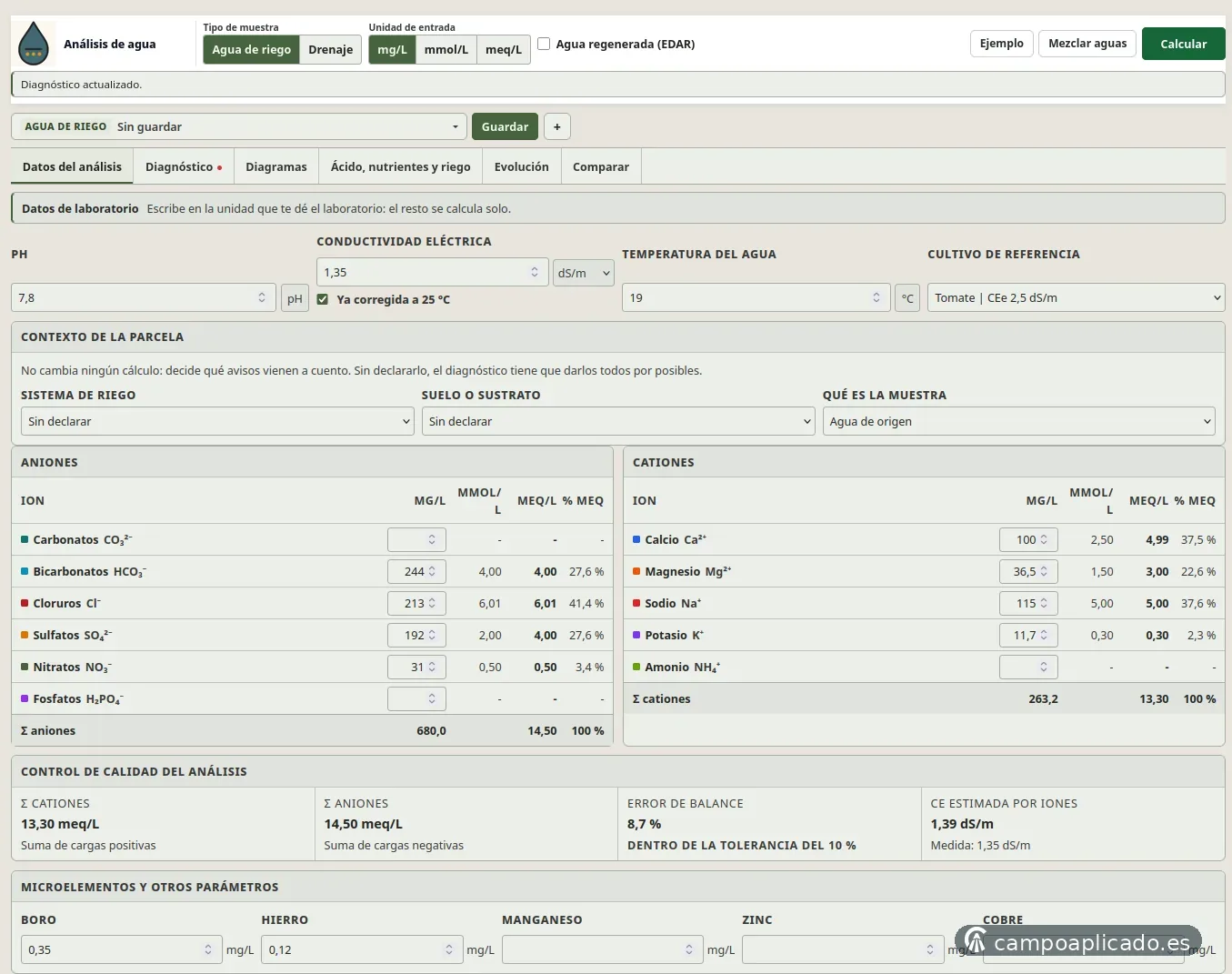
Anions and cations, charge balance in meq/L, estimated EC and analysis quality control.
Features
- Analysis data: Anions, cations and trace elements in mg/L, mmol/L or meq/L, with charge balance and quality control.
- Diagnosis: Salinity, sodicity, FAO 29 infiltration, clogging and biofilm, with management priorities.
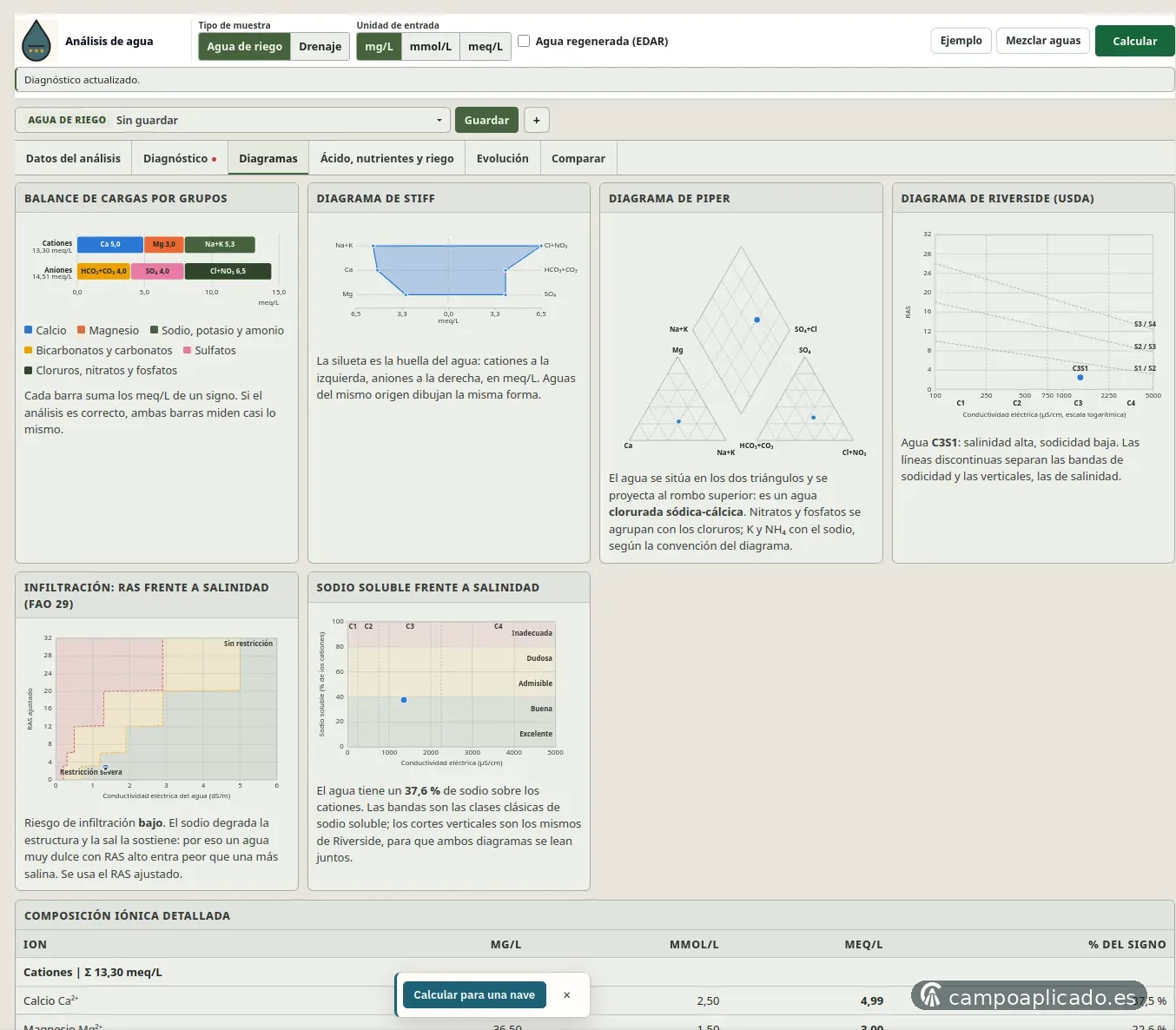
- Diagrams: Stiff, Piper, Riverside (USDA), SAR against salinity and detailed ionic composition.
- Acid, nutrients and irrigation: Acid dose to acidify the water, nutrients supplied by the water and leaching fraction.
- Reuse: Reclaimed water under RD 1085/2024: use, barriers, minimum control programme and compliance.
- Drainage reading: Measured volumes and salt balance per m³ applied.
- History and comparison: Series of analyses from one water source, compared indices and overlaid Stiff, Piper and Schoeller diagrams.
Inputs
Anions and cations from the analysis in mg/L, mmol/L or meq/L. pH, EC, trace elements and other laboratory parameters. Control programme parameters, for reclaimed water.
Results
Charge balance by group and analysis quality control. SAR, FAO 29 infiltration, Riverside classification and Stiff, Piper and Schoeller diagrams. Management priorities, clogging risk, acidification and leaching fraction.
Calculation conditions
The diagnosis corresponds to the sampling date; the composition of a well changes over the season. Each value is interpreted in the unit selected for its block: mg/L, mmol/L or meq/L. Clogging risk is calculated from the water composition.