Calculates the rate of one organic material or a blend for a target of nitrogen, organic matter, carbon, phosphorus, potassium or budget. Gives available nitrogen by year, carbon retained in the soil, P, K, Ca and Mg supply, salts and metals, and applies the nitrogen cap in vulnerable zones.
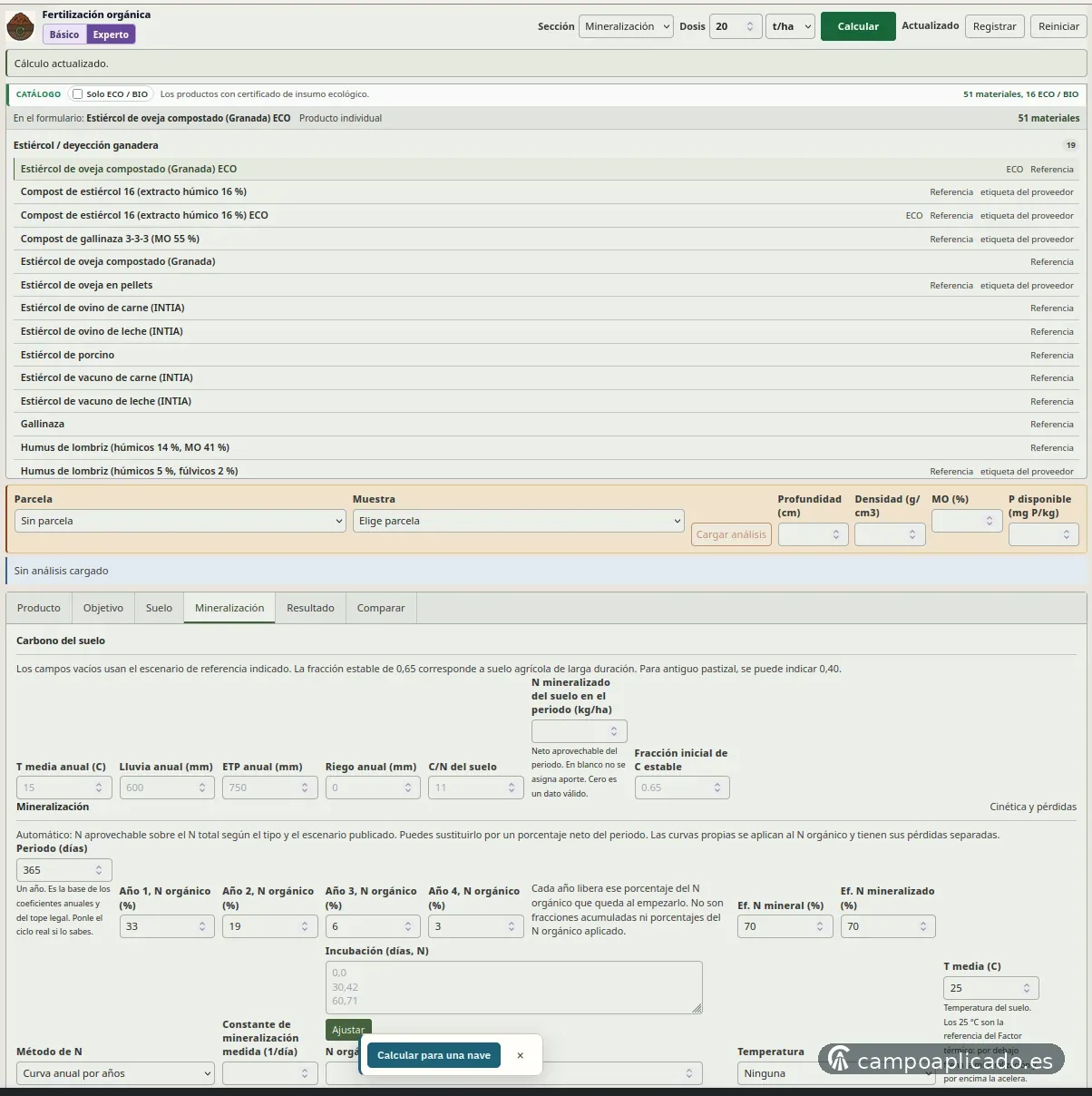
Manures, compost, vinasse, humic amendments and organic farming inputs with their composition.
Features
- Material and blend: Catalogue or own materials, blends of several materials and saving to the own catalogue.
- Product data: Composition on dry or fresh matter, nitrogen forms, humic fraction, micronutrients, water extract, salts and metals.
- Target: Nitrogen, final organic matter, carbon, phosphorus or potassium in ppm, budget or nitrogen cap in vulnerable zones.
- Soil and carbon: Soil data, climate, irrigation and stable carbon fraction for the carbon balance.
- Mineralization: Organic nitrogen available by year, measured mineralization constant, temperature, moisture and losses by leaching, denitrification and volatilization.
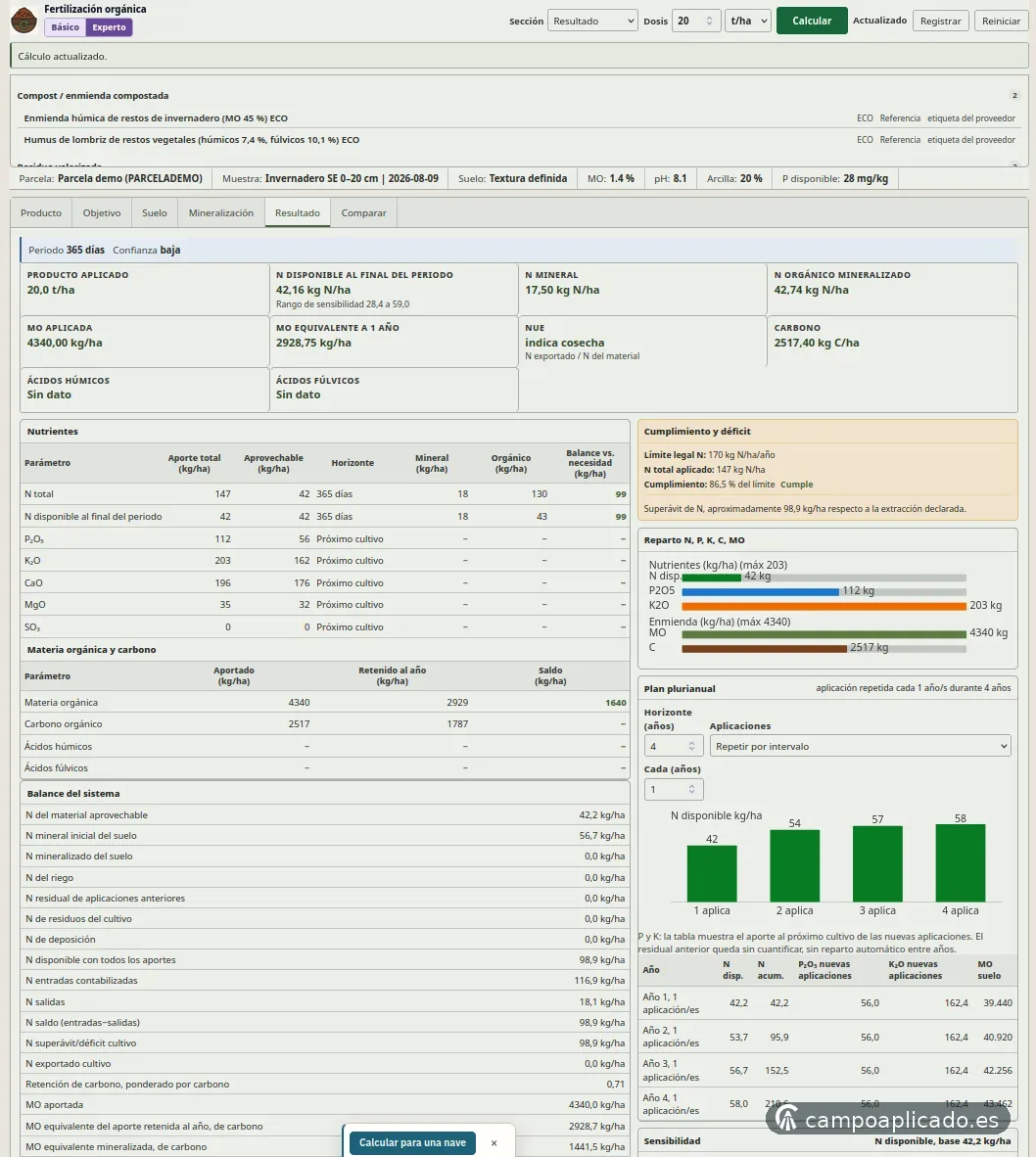
- Result and comparison: Total and available supply of each nutrient, balance against requirement, repeated applications over the plan horizon and comparison of alternatives.
Inputs
Catalogue material or own composition: carbon, nitrogen by form, P, K, Ca, Mg, micronutrients and water extract. Soil: depth, density, organic matter, available phosphorus, texture and carbonates, or saved analysis. Target, price, climate, irrigation and planned applications over the plan horizon.
Results
Rate in t/ha, kg/ha, m³/ha or L/ha and cost per hectare. Available nitrogen by year, losses and balance against crop requirement. Carbon supplied and retained, total soil carbon and P₂O₅, K₂O, Ca and Mg supply.
Calculation conditions
Composition is declared on fresh or dry matter, and the chosen basis sets the units supplied. Mineralization is calculated with the soil temperature and moisture entered. In nitrate vulnerable zones, the legal cap on organic nitrogen per hectare and year limits the rate.