Calculates the solution applied by an injector that is already loaded. Adds the contribution of the irrigation water and the recirculated drainage, calculates EC with the measured curve of each product and checks it against the probe reading.
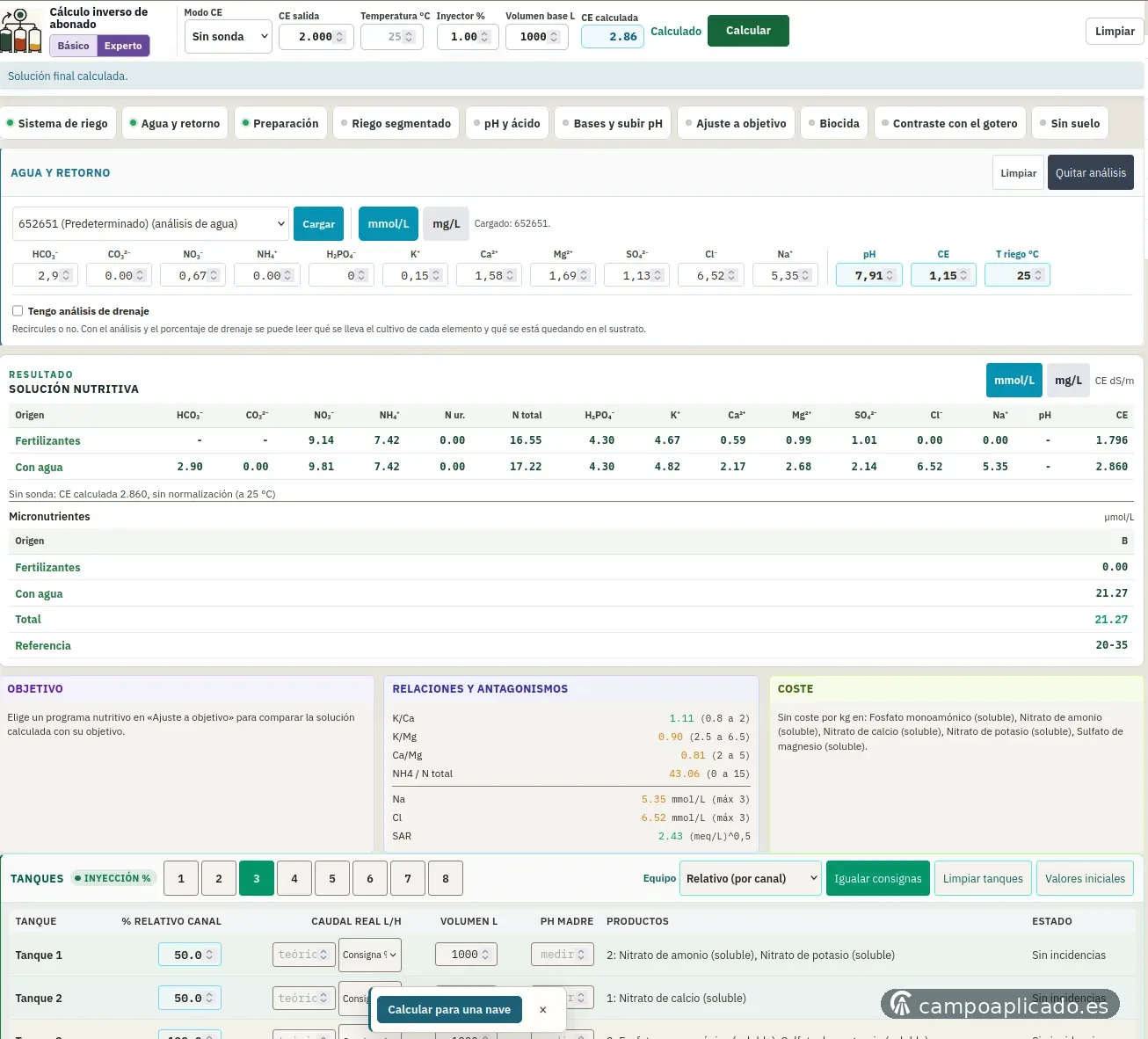
Final composition ion by ion in mmol/L and mg/L, ratios and antagonisms, and water contribution against fertilizer contribution.
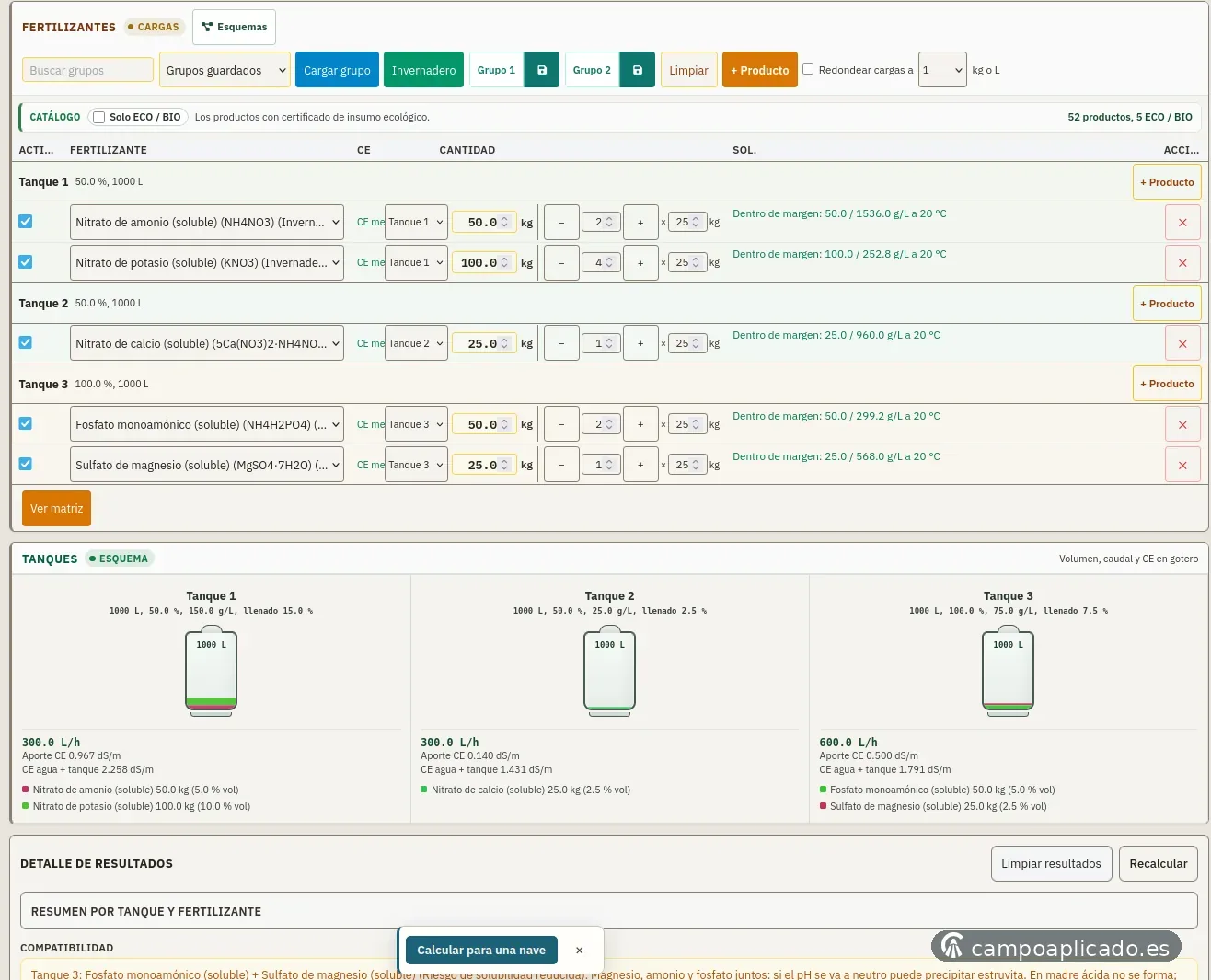
Features
- Tanks and fertilizers: Products and amounts per tank, solubility of each load, saved distribution layouts and compatibility matrix.
- Water and return: Ions from the irrigation water and the recirculated drainage, with the share of each.
- EC with or without probe: EC calculated from tanks, water and injection, or normalized with the measured outlet EC, with the expected reading at probe temperature.
- pH, acid and bases: Acid dose for the pH set point, residual alkalinity and bases for soft water.
- Fit to target: Loading of a nutrient solution programme and adjustment of tank loads to the target, with locked products.
- Pulsed irrigation and dripper check: Phases of pulsed irrigation, emitter and injector flow measurement, and measured EC and pH against calculated values.
- Ratios, cost and report: Cation ratios and antagonisms, load cost, preparation recipe and report.
Inputs
Product and amount loaded in each tank, with the tank volume. Injection percentage or flow of each tank. Irrigation water analysis and, with recirculation, the saved drainage.
Results
Composition of the applied solution, ion by ion, in mmol/L and mg/L. EC at the dripper, split into water contribution and fertilizer contribution. Nutrient ratios, load cost and preparation and injection recipe.
From the loaded tank to the solution at the dripper
A solution calculator starts from the target solution and returns the kilos of each fertilizer. Inverse calculation starts from the kilos loaded in each tank, the stock solution volume and the injection percentage, and returns the composition reaching the dripper.
The contribution of the irrigation water and, with recirculation, of the drainage is added to that composition. The result shows the water contribution and each tank contribution separately, to review a recipe in use or locate an EC difference.
EC calculated with the measured curve of each product
The usual EC estimate multiplies the product coefficient at 1 g/L by the dose. For ordinary salts, between 1 and 3 g/L, the error is between 1 and 5 %, within the error of a field probe.
In weak acids and adducts the coefficient falls as concentration rises. Urea phosphate loses 33 % of its coefficient between 1 and 3 g/L: the linear estimate gives 1.50 mS/cm at 3 g/L and the datasheet measures 1.00. For these products the tool uses the measured datasheet series.
Measured and estimated EC of urea phosphate
- Estimated EC, linear rule
- Measured EC, datasheet
Urea phosphate 17.5-44-0: measured against estimated
Manufacturer datasheet, distilled water at 20 °C, against the linear estimate from the 1 g/L coefficient (0.50 mS/cm per g/L).
| Dose | Measured EC | Estimated EC | Deviation | pH |
|---|---|---|---|---|
| 1 g/L | 0.50 mS/cm | 0.50 mS/cm | 0 % | 2.7 |
| 2 g/L | 0.85 mS/cm | 1.00 mS/cm | +18 % | 2.6 |
| 3 g/L | 1.00 mS/cm | 1.50 mS/cm | +50 % | 2.6 |
| 10 g/L | 2.50 mS/cm | 5.00 mS/cm | +100 % | 2.3 |
| 50 g/L | 12.00 mS/cm | 25.00 mS/cm | +108 % | 2.1 |
The tool interpolates between the measured datasheet points. Datasheets with a single EC value are calculated with that coefficient.
Frequently asked questions
Why does the calculated EC differ from the head unit reading?
The usual causes are three: a real injection different from the declared one, a larger water contribution than the one counted, and a product whose EC coefficient falls with concentration. Inverse calculation separates the water contribution from each tank contribution, and the dripper check verifies the injection.
Is the 1 g/L EC coefficient valid at any dose?
For ordinary salts it is valid within the tank working range: between 1 and 3 g/L the deviation is between 1 and 5 %, below probe error. For weak acids and adducts such as urea phosphate the coefficient falls with concentration and the calculation uses the measured datasheet series.
Is the irrigation water analysis required?
It is optional. Without an analysis, the result covers only the fertilizer contribution. With an analysis, the water ions are added to the final solution and the acid, pH and residual alkalinity are calculated: water with 4 mmol/L of bicarbonate changes the acid dose and the solution reaching the root.
Can it be used to review a recipe written by another adviser?
Yes. The amounts loaded in each tank are entered as they are and the resulting composition is calculated. The comparison with the target shows whether the difference comes from the recipe, the irrigation water or the injector calibration.
Calculation conditions
In no-probe mode, EC is calculated with the injection percentage entered; the dripper check verifies the real injection. The composition of each product is the one declared on its catalogue datasheet. EC is given at the datasheet reference temperature and at the temperature entered for the probe.